
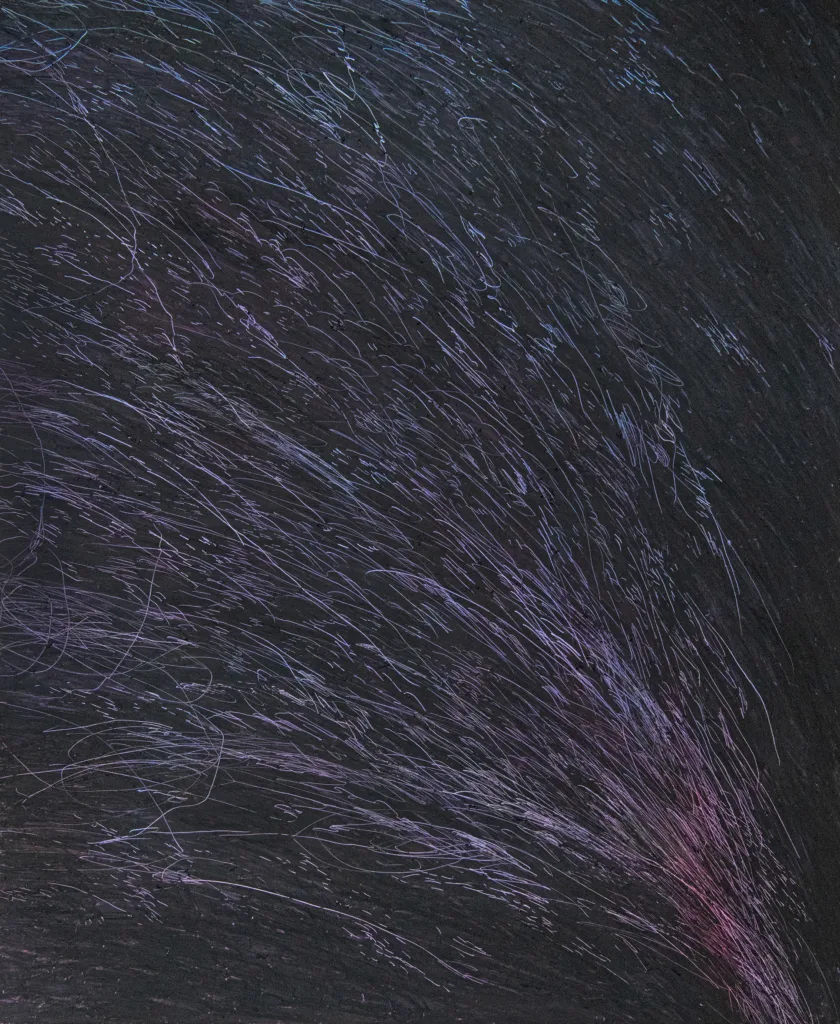
Richard Yu-Tang Lee is an emerging Asian American artist. Lee uses pattern as a vehicle to describe time, articulating the excellence and fallibility of memory. His work is informed by observation of natural phenomena and an ever-present awareness of the self as “viewer.”
Lee has worked as an art director and a cook, professional backgrounds that inform his painting practice and have given way to multidisciplinary projects such as the collaborative 4-year-long design, cooking, and manufacturing performance piece, “Little Brother Chinese Food,” completed in 2025 (documented @littlebrotherchinesefood on Instagram).
“View To A Burnt World” marks Lee’s fifth solo exhibition and third time showing in New Hampshire. Lee is scheduled to exhibit in his hometown of Chicago at the Bulgarca Cultural Center in the summer of 2027.
Lee describes his approach to image-making in terms of immersive experience and existential reflection:
“My expansive oil pastel drawings engulf the viewer in a space of thrilling drama. Illustrated in a profusion of layered marks, these images are constructed from an invented vernacular that combines archetypal allegory with anatomical details pulled from years studying the human skeleton. Accompanying the large format oil pastel pieces are a series of recent paintings that abstractly explore similar themes of existential understanding and human perception. In the “Rain In A Burning Garden” series, intense drama is evoked while evading strict illustration. Raindrop-shaped stokes are tiled together creating a color field that alludes darkly to traditional European landscape painting. I use repetition in my work to connect to time, drawing parallels between the rhythm of strokes and the way one moment falls unstoppably after another. The raindrops overlap or smear each other, mimicking the ways in which memories can change each other or become recontextualized over time. Many of these pieces are adorned with glitter. This heightens their sense of kinesis and creates a rich, textured surface that plays with light wherever it is displayed. The softness of these pieces allow the viewer’s eye to move slowly through the paintings, distinguishing the features of the scene at a meditative pace. In the tradition of process-oriented artists like Iria Leino or Hiroyuki Doi, the “rain” stroke also becomes a kind of unit of measure. The works are an accounting, of rain and brush strokes of course, but also tears, breaths, human beings, cells, ideas, etc. When faced with a multitude of anything, they can seem monotonous and unspecial, but the wild amount of strokes that make up these works ultimately calls the viewer in to revel in their uniqueness, rarity, and the sanctity of these kinds of things, no matter how numerous they may seem.”